Griffon+Remote GORM+X: Inspirations for the Best RIA Horse!

Today I explain a possibility of a pure Java-based client/server application (the client side should be a Rich Internet Application) with a database backend.

I know that other people might already had this idea and others implemented this in a different way and Griffon is on the way, but let my explain it now in (more) detail. It is only an aggregation of existing tools.

How should it look like?

We simply replace the HTML-view of an ordinary Grails application with Griffon! So instead of a browser we will have the mature JVM and we could programm all in Java/Groovy! No JavaScript, no HTML, no CSS, no …!

(Ups. No CSS? Okay we could use css on the desktop, too)

Shouldn’t this be an easy task to replace the V in an MVC application? The problem lays in the detail. E.g. do we need the full GORM functionality on the client side (‘remote GORM’)?

The cayenne framework (a nice hibernate alternative) supports the so called remote object persistence which would be great for this kind of application. They use the hessian library to communicate over HTTP from the client ‘over’ the server to the database. So, the db-programming-style on the client is nearly identical to that on the server!

So, do we need Person.findByXY and all the other, useful methods on the client? I fear tweaking hibernate is necessary but maybe with some grooviness we could avoid this!?

Another simpler approach would be to use the already available services of Grails for the client side. With Xml (Un-)Marshalling or SOAP like it was done before? But hmmh, I prefer the cayenne way … its groovier!

So, what do we need for our 3 tier pure Groovy solution?

We’ll need Grails!

To be a bit more specific: we would actually only need the GORM plugin (and Spring) from the Grails project for the server to communicate to the DB and manage the migrations.

We’ll need Griffon!

We need the full Griffon stack for the client. And if we only use GORM from Grails we will use Griffon also on the server side, I guess.

So either GORM+Griffon+Griffon (db+server+client), which would be more consistent

or GORM+Grails+Griffon which could be easier to implement at the moment.

We’ll need Spring Rich Client!

We need some nice to have packages from the Spring Rich Client project for the client side: validation, window-docking, master-details stuff, …

We’ll need the Hessian Library!

Additionally to the GORM plugin we will need the Hessian library to easily (!) communicate between the client and server. (Short explanation: Hessian library is RMI without drawbacks.) Later on we could implement a remote GORM with the help of this library (see above)! Without this functionality we won’t have fun: either we can only implement a two tier applications (client+db) or the programming is as slow as it would be with an ordinary non-groovy desktop application (via SOAP etc).

We’ll need JavaFX!

Why do we need JavaFX if we already have Groovy as the UI DSL? Marketing! That would mean a broader audience and maybe some tinyย  support of Sun ๐Ÿ˜‰

Another feature of JavaFX would be that designers could create good looking SwingUIs for us without knowing Java/Groovy.

XML Marshalling

TimeFinder-Planner a Primitive MigCalendar Alternative?

Yesterday I annouced a new version of TimeFinder. With that version a new and very simple component called TimeFinder Planner is included and can be easily integrated into an existing Swing or Spring RC project. It is already mavenized but I can deploy a full jar if necessary.

Of course it is not as feature reach as MigCalendar, butย  you can use it as a read only calendar component in you own apps – it is Open Source (Apache License 2), small (<30KB) and has only relative few dependencies (~1MB). It supports ‘conflicting’ events, i.e. if events would be at the same time.

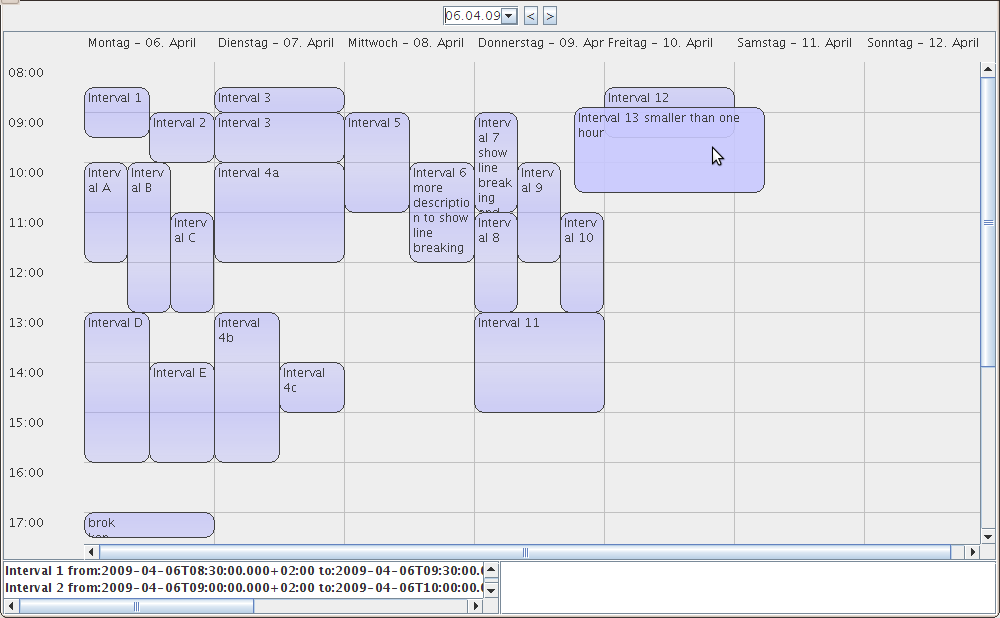
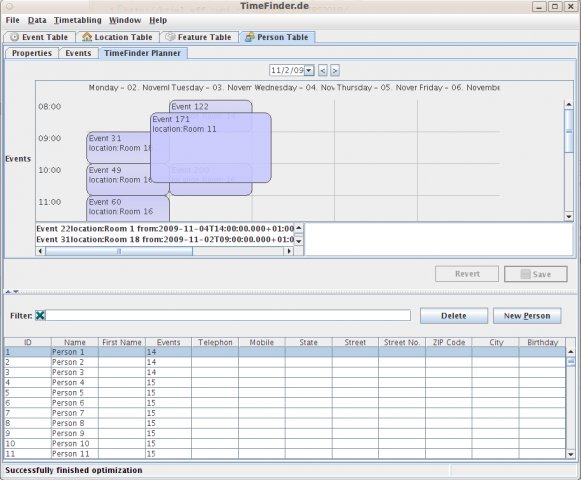
Look here for some screenshots in my TimeFinder application:

At the same time you can ‘zoom’ into one event simply via the “mouse over” action. And it should be able to handle any possibility of conflicts (overlapping events):

The performance should be also good even for a lot of events per week (independent from all events!). This cannot be seen in a screenshot but you can try TimeFinder and import the data of JavaOne 2009 via the ‘File’ menu item. Look here for the video explanation.

TimeFinder v4 Released – Automatic Educational Scheduling

Today the TimeFinder Team (its me ;-))
announces the availability of TimeFinder v4!

TimeFinder allows universities and schools to reduce and even avoid conflicts in the timetable! TimeFinder will improve the work of the human timetabler at the institute. A lot of work which would be done by hand to create the educational schedule could be done with TimeFinder.

TimeFinder is completely free and independent of the operating system (via Java 6). The power of TimeFinder is its algorithm. It eliminates the hard-conflicts of nearly all datasets of the International Timetabling Competition 08 in under 20 seconds on a normal laptop. And it can be applied on real data like the one from University of Bayreuth.

Pictures tells a lot more than 1000 words, so here is a video as introduction

and here are some screenshots:

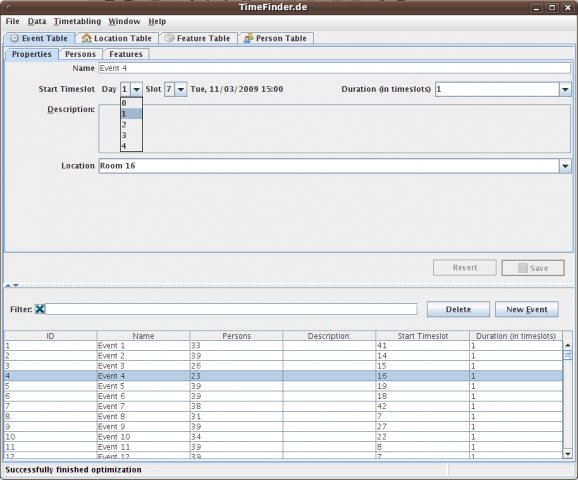
The first screenshot is how editing of events works

  1. create a new event
  2. then set the name
  3. and specify the start and duration
  4. after this you can add some visitors under Event Table->Persons

edit-events

And here you see how TimeFinder optimized an instance of the International Timetabling Competition 08:

after-optimization

See some more screenshots and look again here for the video documentation.

Start TimeFinder right now via WebStart! Or download the jar which is faster!

New Features

The TimeFinder Team worked hard to add the following features in this version for you:

  1. Events with any duration are now possible – without performance losings! (before only duration=1 was possible)
  2. A more robust and lightweight Swing component the TimeFinderPlanner to display the schedule/timetable of all locations and persons was implemented and replaces the JavaFX component hassle. This component is small (<30KB) and but has some dependencies (1MB). It has the same purpose as MigCalendar, but is of course not as powerful as this.
  3. Import of text files (tab separated, comma separated data). XML was already supported in previous versions
  4. Auto-import for the last imported file
  5. Cloning entities is now possible
  6. Anonymize data, so that institutes could give away its data for performance-tests and other research projects.
  7. Import of the data for University of Bayreuth (Germany) and the possibility to optimize this data set with >1500 events; >100 locations; >600 resources (persons/course of studies) is now possible and shows how other institutes could use its existing data with TimeFinder.
  8. Removed a lot of deprecated classes and removed unused dependencies (now ~11MB)
  9. Now the English TimeFinder is fully translated into German too. Translation is now simplified with a small tool.
  10. A new maven module called algo was created (~3MB), to reduce coupling of the algorithm to the GUI. Now it is theoretically possible to deploy the algorithm without the spring dependency e.g. to an optimization server.

Support

No software is complete or bug-free, and so is TimeFinder which is beta software at the moment. You are free to support TimeFinder with your constructive critique, blog posts or even money if you like to make it better. Feel free to contact me or raise an issue if you find a bug.

Check the documentation or watch an introductive video to get an overview. Keep in mind that updating documentation is still work in progress.

You can win

If you know some Java and like coding GUIs, databases or algorithms you can contact me and win experiences via joining the project!

Especially the calendar component TimeFinderPlanner could be alluring for people with Java2d experiences or interests in this area.

Thanks!

This application wouldn’t be the same without the following nice open source projects:

… and last but not least thanks to NetBeans – the only IDE you need
and Yourkit profiler, which offers open source projects a free license!

TimeFinder – Powerful Optimization Algorithm, RIA and more

TimeFinder is an Open Source Timetable Optimizer for universities and schools, which uses the Spring Rich Client project to create an easy to use application with a nice user interface, a database and … more bla bla …

ok, it is a bit dingy headline and a more dingy introduction, but I would like to invite you to test the latest development version v4 of TimeFinder now! And without such a headline you woudn’t have read this. And I feel that I would like to release TimeFinder in the next weeks, so I need some beta testers. Go here to see some screenshots.

Get the dev version of TimeFinder here, double click the jar (optionally read the documentation for v1) and tell me:

  1. If you understand the purpose of TimeFinder from the website
  2. If you understand the user interface and how you can insert data
  3. If you find a bug
  4. If you need other features

Any feedback is welcome! Please contact me at peathal AT yahoo |dot| de, post an email to the mailing list or simply leave a comment here.

Link of Swing 2.0? And google collection description …

Just two links:

  • PureSwing Description taken from the homepage: PureSwing is Java GUI library with user API nearly identical to Swing GUI toolkit. It’s based on GNU Classpath’s reimplementation of Java Swing classes.
    Nice:

    • See the homepage for a feature overview! It is more a “removing overview” ๐Ÿ˜‰ e.g.: removed AWT dependency!
    • Joining the project is very easy: just send in the patch and if it’s good it will be commited.
    • License: PureSwing is distributed under GPLv2+ with Classpath exception (allows linking with proprietary programs). This license is effectivelly less restrictive than LGPL, …
    • There is support for NetBeans GUI builder

    Size for version 20091025: 2.1 MB (core); 2.8 MB (dependencies)

  • Google collections overview

    Dependency Injection in Java!

    Now the JSR330 is final! This was really fast (because of JEE 6)!

    From the JSR:

    This JSR will standardize:

    • A set of annotations for use on injectable classes
    • A typesafe, user-friendly injector configuration API that provides an integration point for higher level dependency injection configuration approaches

    The code is located at google.